

Quit Porn: 10 Science-Backed Benefits
Quitting pornography offers a range of benefits that can improve your mental clarity, emotional well-being, and relationships. Research highlights how stopping this habit can lead to better focus, reduced anxiety, and even healthier intimacy. Here’s a quick breakdown of the key benefits:
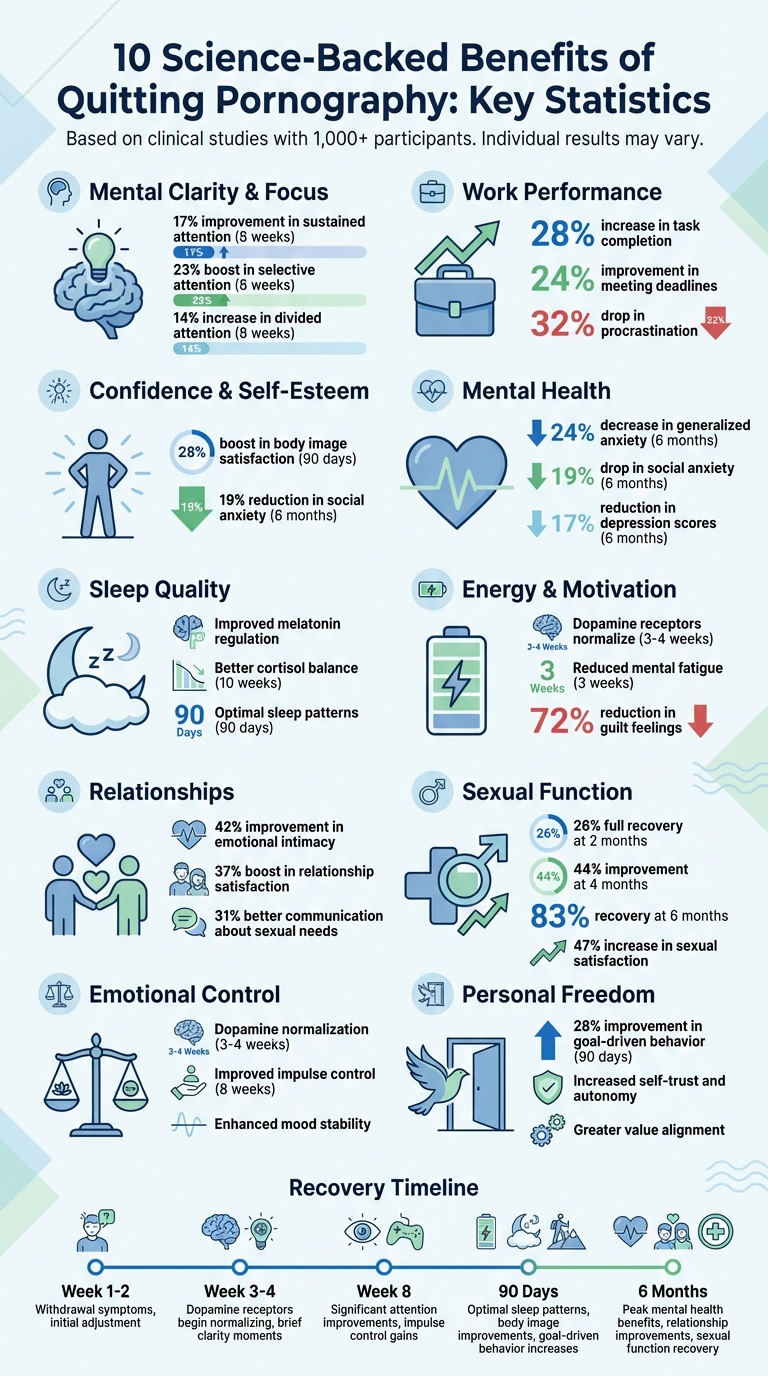
- Sharper focus and mental clarity: Studies show a 17% improvement in attention after 8 weeks of abstinence.
- Improved work performance: Task completion rates increase by 28%, with less procrastination.
- Higher confidence: A 28% boost in body image satisfaction is reported within 90 days.
- Reduced anxiety and depression: Participants experienced a 24% drop in anxiety and a 17% decrease in depression scores after six months.
- Better sleep quality: Abstinence helps regulate melatonin production, improving sleep cycles.
- Increased energy and motivation: Dopamine levels reset, leading to more drive for daily activities.
- Healthier relationships: Emotional intimacy improves by 42%, with better communication and connection.
- Improved sexual function: Recovery from pornography-induced dysfunction is often seen within 6 months.
- Enhanced emotional control: Mood stability and impulse management improve within weeks.
- Stronger self-worth: Breaking free from guilt fosters personal growth and freedom.
These benefits highlight the brain and body’s capacity to recover, paving the way for a more balanced and fulfilling life. Starting today can lead to positive changes in as little as a few weeks.
10 BENEFITS of Quitting Porn & Rewiring Your Brain
1. Clearer Thinking and Less Brain Fog
One of the first noticeable changes after quitting pornography is an improvement in mental clarity. Many describe it as their mind becoming sharper, free from the persistent fog they may not have even realized was there. This happens because chronic pornography use impacts dopamine receptors, reducing their sensitivity to manage overstimulation. When you stop, these receptors gradually recover, allowing your brain to regain its natural ability to focus and process information effectively.
The science backs this up. Studies show that after just 8 weeks of abstinence, participants experienced a 17% improvement in sustained attention, a 23% boost in selective attention, and a 14% increase in divided attention [1]. Neuroimaging research has also revealed that heavy pornography use can reduce gray matter volume in the brain's reward system - a change that can reverse with continued abstinence [4].
It's like my brain was wrapped in cotton for years, and I didn't even realize it until the fog started lifting. - Alex, Programmer [3]
The recovery process takes time. During the first 1–14 days, withdrawal symptoms like irritability and even worse brain fog can make things feel harder. By weeks 2–4, you might notice brief moments of improved focus as dopamine receptors begin to recalibrate. Over the following months, many report significant gains in working memory and mental stamina. This newfound clarity doesn’t just sharpen your thinking - it often leads to better performance in other areas of life.
To support your brain during this recovery, certain habits can make a big difference. Regular aerobic exercise, such as 30 minutes of daily activity, increases Brain-Derived Neurotrophic Factor (BDNF), which improves blood flow to the brain. Engaging in challenging cognitive activities and sticking to a consistent sleep schedule can also help consolidate memories and clear out metabolic waste. Together, these practices can accelerate your progress toward mental clarity, setting the stage for enhanced focus and productivity down the road.
2. Better Focus and Work Performance
Stepping away from pornography can lead to noticeable improvements in mental clarity and work productivity. Research from Cornell University highlights this with some compelling statistics: individuals who quit pornography saw a 28% increase in task completion, a 24% improvement in meeting deadlines, and a 32% drop in procrastination [1]. These changes can dramatically enhance your professional performance, providing a strong foundation for better focus during recovery.
A key factor in these improvements lies in the brain's recalibrated dopamine response. By moving away from compulsive behaviors, your brain's reward system begins to function more effectively. Blair Bisher from BPB Counseling Group puts it succinctly:
Quitting porn starts the brain's recalibration process [7].
This recalibration allows you to focus on deep, meaningful work, leading to higher-quality results.
The recovery process also benefits the prefrontal cortex, the part of the brain responsible for decision-making, impulse control, and planning. As this area heals, you'll find it easier to solve problems, manage stress, and maintain focus. The energy once spent battling urges or dealing with the aftereffects of compulsive behavior can now be directed toward advancing your career and tackling creative challenges.
Adopting structured daily routines can further support this transformation. Scheduling focused work blocks alongside physical activity helps train your brain to operate without constant digital distractions [7]. Breaking larger projects into smaller, manageable tasks provides a natural sense of accomplishment, delivering dopamine rewards as you complete each step.
It's worth noting that some individuals may experience a temporary "flatline" phase as their dopamine system adjusts [6][2]. This is a normal part of the process and often signals that a significant boost in mental clarity and motivation is just around the corner.
3. Higher Confidence and Self-Esteem
Quitting pornography can reshape how you see yourself. According to research from the University of Sydney, young adults (ages 18–25) who quit pornography experienced an average 28% boost in body image satisfaction after just 90 days [1]. This shift often comes from stepping away from the unrealistic and highly polished images and performances portrayed in pornography. Without constantly comparing yourself to these unattainable standards, it becomes easier to view yourself more positively, laying the groundwork for improved self-trust and social confidence.
Beyond physical self-image, abstaining from pornography helps rebuild self-trust. By sticking to your commitment, you prove to yourself that you can follow through on personal goals.
Nothing builds confidence like keeping promises to yourself. Successfully abstaining from pornography creates a positive feedback loop of self-trust and personal integrity [2].
This sense of accomplishment strengthens self-control with each passing day.
Another important aspect is breaking free from the cycle of shame often tied to pornography use. Studies show that 72% of men report feelings of guilt after using pornography [2]. Letting go of this guilt can open the door to more genuine self-expression and better social interactions. In fact, a six-month study of over 1,000 participants revealed a 19% reduction in social anxiety among those who quit pornography [1].
People in recovery frequently notice improvements in everyday interactions - like making better eye contact, speaking with more clarity, and projecting confidence through body language. While these changes may take time, with noticeable progress often occurring within one to three months and deeper confidence developing after six months, occasional setbacks can provide valuable lessons rather than reasons to quit. These gains in self-esteem highlight the broader mental and emotional benefits of leaving pornography behind.
4. Less Anxiety and Depression
While pornography might seem like a quick fix for stress or negative emotions, it often does more harm than good. Research highlights that relying on pornography as a coping mechanism can lead to feelings of guilt and internal conflict, ultimately increasing psychological distress [11][12]. By quitting, you interrupt this harmful cycle, giving your brain the opportunity to adopt healthier ways of managing emotions.
Quitting pornography is also linked to noticeable reductions in anxiety and depression. For example, a study involving over 1,000 participants found that anxiety levels significantly dropped within just 2 to 3 weeks of abstinence [1]. The benefits only grow over time: after six months, participants reported a 24% decrease in generalized anxiety, a 19% drop in social anxiety, and a 17% reduction in depression scores [1].
Internet pornography consumption might represent a defense mechanism against excessive stress... [but] self-exposition to pornographic material may create guilty feelings and internal conflict. – Michal Privara, MA, Center for Neuropsychiatric Research of Traumatic Stress [11]
These improvements are rooted in the brain's recovery process. Long-term pornography use dulls the dopamine reward system, making it harder to find joy in everyday activities. When you quit, dopamine receptors begin to reset, typically within 3 to 4 weeks [1]. This reset helps stabilize mood and reduces feelings of emotional numbness.
It’s worth noting that withdrawal symptoms might temporarily spike during the first 2 to 4 weeks as your brain recalibrates. Healthy coping tools like mindfulness, regular exercise, or leaning on friends for support can make this adjustment period easier [1][11].
5. Better Sleep
Giving up pornography can have a noticeable impact on your sleep quality. Studies reveal that pornography use disrupts melatonin production, which is crucial for regulating your body's natural sleep-wake cycles [13]. By quitting, especially avoiding late-night use, your brain has the chance to recalibrate its circadian rhythms and produce melatonin at the appropriate times.
Research published in the International Journal of Neuropsychopharmacology found that a 10-week period of abstinence led to better sleep quality and more balanced cortisol levels [1]. Cortisol, the hormone responsible for managing stress, can interfere with falling asleep when its levels are off.
One of the first changes I notice in clients is disrupted sleep patterns. It's not just about staying up late watching porn - research published in the Journal of Sleep Research shows that screen-based sexual content significantly impacts melatonin production and circadian rhythms. – Devin McDermott, Recovery Coach, BeFree [13]
Many people notice improvements in their sleep within the first month of quitting, with optimal sleep patterns often developing after around 90 days [13]. Replacing late-night habits with relaxing activities like reading or meditation can further support this transition, helping your body adapt to healthier routines.
Those who quit often report having more time for proper rest, naturally gravitating toward earlier bedtimes and longer periods of restorative sleep [9][10]. Better sleep not only boosts energy levels but also enhances mental clarity and emotional stability, complementing the other benefits discussed earlier.
6. More Energy and Motivation
Quitting pornography doesn’t just clear your mind - it can also give you a noticeable boost in energy and drive. Regular pornography use tends to desensitize the brain's reward system, which can sap motivation for everyday activities. When you stop, dopamine receptors begin to reset, helping you rediscover joy and satisfaction in ordinary tasks and goals [1]. This renewed energy doesn’t just enhance mental clarity - it also fuels a stronger sense of purpose in daily life.
Research highlights this transformation. Studies on single men show that just three weeks of abstinence can reduce mental fatigue and increase wakefulness. With continued abstinence, cognitive stamina and overall productivity see even greater improvements [14][1].
Breaking free from pornography also conserves emotional energy. For many, the cycle of guilt and self-criticism tied to pornography use can be draining. Research indicates that 72% of men report feelings of guilt after viewing pornography, often due to secrecy and self-judgment [2]. By stepping away from this cycle, you free up emotional energy, which can then be channeled into more meaningful pursuits.
It can feel really good to bring some order into an area of your life that feels out of control. The sense of satisfaction, the internal pride… people feel a lot more at peace. – Mark Baxter, Psychologist and Director, Australian Association of Psychologists [15]
It’s worth noting that you may experience a temporary "flatline" period, usually between weeks 2 and 6, where motivation might dip as your brain adjusts [6]. This is a normal part of the healing process. To keep your energy levels up during this time, try channeling your focus into physical activities like exercise, or explore hobbies and social activities to fill the time once spent on pornography.
7. Healthier Relationships and Intimacy
When mental clarity improves and self-esteem grows, personal relationships often flourish. In fact, couples where one or both partners stopped using pornography reported a 42% improvement in emotional intimacy and a 37% boost in relationship satisfaction [1]. These changes can profoundly reshape how partners connect with each other.
A major shift occurs when you stop viewing your partner through the distorted lens of digital stimulation. Pornography often trains the brain to objectify others, reducing them to physical attributes rather than recognizing them as whole individuals. Quitting allows you to see your partner for who they truly are - their personality, emotions, and unique traits. This transition from objectification to genuine appreciation lays the groundwork for deeper, more meaningful intimacy.
Porn distorts natural connection by reducing intimacy to mere physical stimulation, leaving a hollow experience. - Matt, Talking Sober Forum Member [16]
Letting go of pornography also removes the secrecy and shame that can erode trust. Without these barriers, couples can engage in honest conversations about their struggles, goals, and needs. This kind of openness fosters vulnerability, which is essential for strong relationships. After quitting, couples reported a 31% improvement in their ability to communicate about sexual needs [1].
Abstaining from pornography not only strengthens communication but also enhances physical intimacy. Individuals who quit reported a 47% increase in sexual satisfaction with their partner [1]. Without the constant comparisons to unrealistic scenarios, real-life intimacy becomes more fulfilling. A 2020 longitudinal study spanning 18 months found that couples who eliminated pornography experienced fewer conflicts and greater relationship stability compared to those who continued its use [1].
It’s important to note that recovery is a process. Some people experience a temporary dip in libido as their brain adjusts, which is a normal part of healing. This doesn’t signal a failing relationship - it’s simply your nervous system recalibrating. During this time, focus on building emotional connections through quality time, shared experiences, and open dialogue. Replacing fleeting stimulation with authentic bonds leads to more satisfying and lasting intimacy.
8. Improved Sexual Function
One clear benefit of quitting pornography is the restoration of healthier sexual function. Overuse of pornography can disrupt the brain's reward system, making real-life intimacy feel less exciting compared to digital content. When you stop, your brain begins to reset, with dopamine receptors typically normalizing within 3–4 weeks [1].
Research backs up this recovery process with measurable results. In a clinical study involving 350 men with erectile dysfunction unrelated to physical issues, 26% achieved full recovery within 2 months of quitting pornography, 44% saw noticeable improvement within 4 months, and 83% experienced recovery by the 6-month mark [1]. These findings highlight that pornography-induced erectile dysfunction (PIED) can often be reversed through abstinence.
The benefits go beyond addressing erectile dysfunction. Excessive pornography use has also been tied to other issues like delayed ejaculation, diminished sexual desire, and difficulty achieving orgasm. A large-scale study of over 14,000 participants found that problematic pornography use was a significant predictor of sexual performance problems for both men and women [17]. By quitting, individuals can reset their natural arousal patterns, making real-life intimacy more fulfilling without needing the constant novelty of digital content.
Problematic pornography use had a significant positive association with sexual functioning problems for both men and women. - Beáta Bőthe, Researcher and Lead Author [17]
Recovery isn’t instantaneous - it requires patience. Experts often recommend a "reboot" period of anywhere from 90 days to 6 months to allow the brain to recalibrate and regain sensitivity to natural stimulation [1].
9. Better Control Over Emotions
Quitting pornography can help you regain control over your emotions and reduce impulsive behavior. This change is closely tied to how the brain heals and adapts. Regular pornography use has been associated with a weakened prefrontal cortex - the part of the brain responsible for managing impulses and emotional reactions. When you stop, this area begins to recover. Dopamine receptors, which play a key role in regulating emotions, start to normalize within 3 to 4 weeks [1]. This adjustment helps stabilize mood by minimizing the extreme highs and lows in brain chemistry. Studies indicate that by 8 weeks, people experience noticeable improvements in impulse control and attention span [1]. By the 6-month mark, individuals reported a 24% drop in generalized anxiety and a 19% reduction in social anxiety [1].
As focus and mood regulation improve, emotional control becomes even stronger. Many people turn to pornography to escape feelings like stress, boredom, or loneliness. Removing this habit forces the brain to find healthier ways to process emotions. In a survey of 90 individuals who quit pornography, many reported feeling significantly less stressed and anxious [8].
During recovery, your brain undergoes a process called synaptic pruning. This process, which occurs mostly during sleep, eliminates unhealthy neural connections and strengthens healthier ones [5]. This is why good sleep is essential during this time - rest allows your brain to reorganize and reinforce positive emotional pathways.
It’s important to note that early on, you may experience mood swings as your brain adjusts. While this temporary discomfort is part of the healing process, breaking free from the cycle of shame and guilt linked to pornography use can lead to greater self-acceptance and emotional stability over time. These improvements in emotional control also contribute to better mental clarity, increased productivity, and stronger relationships, as previously discussed.
10. Stronger Self-Worth and Personal Freedom
Quitting pornography doesn’t just clear your mind and steady your emotions - it also helps you regain your sense of self-worth and personal freedom. The guilt tied to past use can weigh heavily, creating a constant tension between your actions and your values. Breaking out of this cycle removes that shame, giving you the space to rebuild trust in yourself.
Every day you stick to your commitment reinforces your ability to take control of your choices. Over time, this self-trust grows, spilling into other areas of life. Instead of automatically reacting to urges, you start making intentional decisions that align with the person you want to become.
As your brain heals, physical recovery and the normalization of dopamine levels restore the mental clarity needed for true autonomy. Research from the Max Planck Institute shows that after 90 days, individuals experienced increased goal-driven behavior and greater persistence when tackling challenges [1]. For younger adults (18–25), a 90-day break from pornography led to an average 28% improvement in body image satisfaction scores [1].
I can see the world through a new lens. I am no longer a slave to the addiction. – Fight the New Drug [8]
This freedom allows you to live in harmony with your core values, no longer controlled by artificial distractions. The energy once consumed by pornography can now be redirected into meaningful pursuits - whether hobbies, relationships, or personal goals - helping you build a stronger sense of self and a renewed purpose.
Conclusion
Quitting pornography is about reclaiming control over your mind, relationships, and overall life. The benefits outlined earlier highlight how pornography can impact mental clarity, emotional well-being, physical health, and personal connections. Studies show notable improvements in areas like anxiety, sexual function, and mental health when individuals take steps to recover[1]. This demonstrates the brain and body's remarkable ability to heal when given the opportunity.
Creating an environment that supports recovery is key. Tools like website blockers, new routines, and stress management techniques can help you tackle the challenges of early recovery[2]. These practical solutions lay the groundwork for accountability, which is essential for turning effort into lasting change.
One option is Pledgely, a financial accountability app that charges only if the blocker is disabled. Starting at $9.99 per month, it offers customizable daily pledges and works locally to protect your data while safeguarding all apps and browsers.
By adopting these strategies, research suggests that changes - like restored dopamine sensitivity and improved executive function - can begin to appear within weeks[1]. Over time, these shifts can lead to stronger relationships, increased productivity, and improved self-worth. For instance, individuals report a 37% boost in relationship satisfaction and a 28% rise in task completion rates[1].
Starting today could be the first step toward healing your brain, deepening your relationships, and regaining your freedom. Each positive change builds toward a future free from digital distractions and more aligned with who you truly want to be.
FAQs
How long does it take to feel benefits after quitting porn?
You might start seeing positive changes just a week after quitting. Many people notice better mental clarity, improved focus, and a boost in emotional well-being around the 7-day point. These improvements often continue to grow as more time passes.
What withdrawal symptoms are normal when quitting porn?
When stepping away from porn, you might experience withdrawal symptoms like fatigue, irritability, mood swings, anxiety, and cravings. These can sometimes mimic flu-like feelings, particularly during the first few days. The good news is that for most individuals, these symptoms gradually ease as the body and mind adapt to the change.
How can I quit porn and avoid relapsing long-term?
Quitting porn and staying free from relapse involves tackling both the behavior itself and the brain's response to it. Start by recognizing the addiction - acknowledgment is the first step toward change. Next, surround yourself with a reliable support system that can help you stay accountable. It's equally important to identify and steer clear of triggers, replacing old habits with positive, healthier activities that keep you engaged.
Recovery isn't an overnight process. Be prepared for challenges like withdrawal and focus on building new, sustainable routines. Consistency is key - stick with these changes to set yourself up for long-term success.